 HAAI
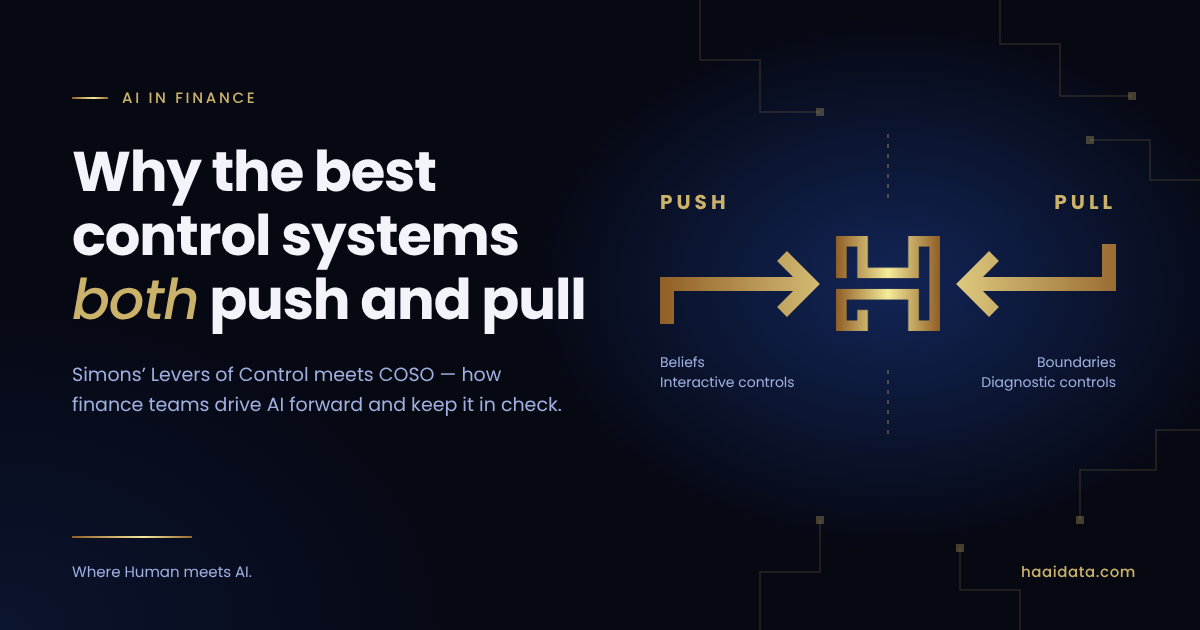
Excitement and caution is how your finance team will approach AI. Where you will see that the teams that gets the results and the most out of it do both, on purpose!
In any finance department today you will find AI and assisting the teams. Rarely officially as a reconcilliation tool or as a forecasting tool or add-on. However, more often then not it arrives unofficially, this happens when a financial or analyst is copying information (table or financial information) into the chat for an analysis or commentary. Technology is no longer a bottleneck, but this opens the real question: How to manage it?!
Two old ideas that fit a new problem
From the days of book research and self-thinking we bring two well-known management frameworks to answer that question.
Our first framework comes from a Harvard professor Robert Simons. In his theory Levers of Control (1995) he defined four levers to help develop your organisation. There are two levers that actually push people:
- Belief: a mission statement that creates a shared purpose for people in what they are trying to achieve
- Controls: information systems that leaders use to talk with their teams about uncertainty and changes
Then you have two other levers that hold people back, they pull you could call it, but in a controlled and useful way:
- Boundaries: clear rules and agreements on what is acceptable and off-limits
- Diagnostic Controls: KPI's and exception reports about whether the company or shared purpose is on track or not
According to Simons it's the purpose of management, especially if you want to be good management, to keep all four in tension.
Our second framework is COSO, it's an internal-controle work that most auditors use. Effective control comes from five elements:
- The right control environment
- Risk assessment
- Control activities
- Information and communication
- Monitoring
Just last February 2026 COSO published further guidance on how to apply these elements or components to generative AI. The main message or summary is to treat AI outputs as claims to be checked and verified, not as facts to be accepted.
Putting them together
Simons tells you how to use the levers or controls to drive change, provided you have a solid strategy as a basis. That basis is essential in his approach. COSO's approach is more about what controls need to be reliable. At HAAI we believe you need both if you want AI in finance:
- Purpose first (belief): talk to your team about why you are using AI. Open discussion and free time for business partnering will invite experimentation in the open, keep silent and the experimentation takes place hidden and silent.
- Clear lines (boundaries): give your team the tools that are approved, data you never ever share in a prompt and when an AI cannot act without a human.
- Measure the machine (diagnostic): track the AI accuracy, how many times people override it, what happens after a model update.
- Talk about the future (interactive): discuss and talk about AI-drive forecasts and scenarios in your conversations with business leaders and teams, not stick to dashboards only.
Two ways it can go wrong
Too much weight or focus on the brakes, meaning boundaries and your KPI's, and you get pilot purgatory: dozens of proofs of concept but very little in production, where staff use the unapproved tools anyway. Too much focus on the accelerator, which means the purpose and enthusiasm, and you get ungoverned scaling (the silence). AI will be touching your financial statements, but without proof (records of what it did or why), and therefore out of control. Research indicates a worry about both, because people abandon algorithms after seeing a single mistake, yet at the same time they over-trust AI on tasks it actually handles poorly.
So where to start
AI is already in your organisation, whether you like it or not, so how to get started on organizing AI in your organisation, in short:
- Find out how AI is now hitting your organisation, which means finding out how your team is already using AI. Cover both sides of the coin: officially and unofficially.
- Create or write a purpose statement (about one page) and an acceptable-use policy. This creates a shared belief and the boundaries for the use of AI in your organisation.
- Put all AI use-cases on a list, assign an owner but also a risk level. Then it's clear where and when to use AI, but also the risks involved. At the same time the owner can help control the risks, but maximize the use-cases.
- Build checks and balances into the high-risk cases before they go live. This helps control the risks, limit the mistakes and therefore promote adoption.
- Start small by picking one AI-supported forecast or scenario(-tool) and use it in your next review or meeting about the topic.
The teams that will embrace AI and get the most of it aren't going to be the ones with the newest toys or tools. It are going to be the ones that balance the push and pulls of their control systems.
In order to support a companies push and pull, especially which side to improve, we created a 67 question program in order to diagnose your company. From there your can then take the necessary steps to balance your control systems and get them to push and pull at the same time. If you are doubting you can start with Quickscan for free after which you can either move on to the full program or get our assistance to get you started!
Quick-scan: Claim your HAAI Data Quick-scan for free here!
Full program: Go for the full LCAT Program (download the LCAT-Checklist)